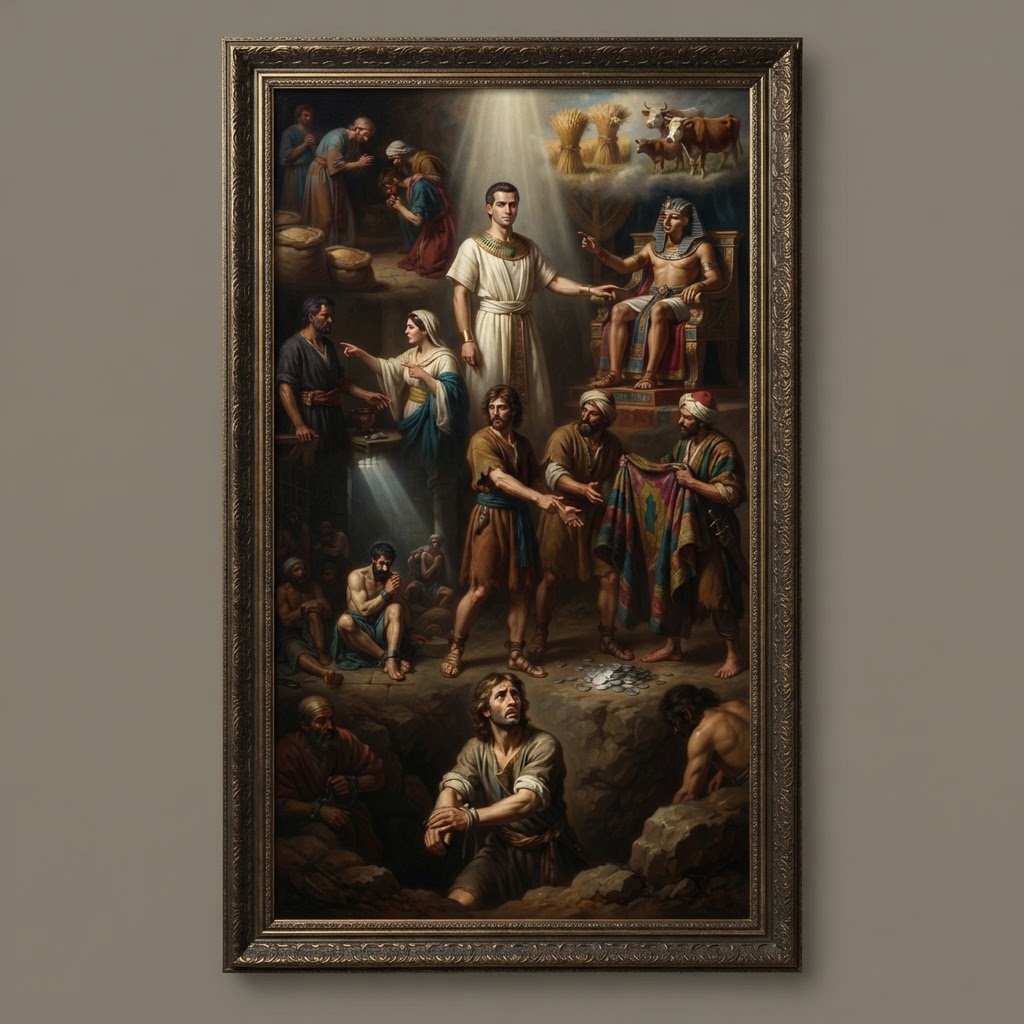
Joseph: Betrayed but Not Forgotten
Betrayed by his brothers. Sold into slavery. Falsely accused. Forgotten in prison. Yet through it all, God was weaving a story of redemption. Joseph's journey from the pit to the palace is a blueprint for trusting God in the dark.
Choose Your Experience
Joseph: Betrayed but Not Forgotten
The Hook
What if the worst thing that ever happened to you was actually the setup for the best thing God could do through you? What if the pit was the first step toward the palace — and you just couldn't see it yet?
Joseph's life is the ultimate proof that God writes straight with crooked lines.
The Story
Joseph was the eleventh of twelve sons. His father Jacob loved him more than the others — and made no secret of it. He gave Joseph a special robe, a coat of many colors. His brothers resented him.
Then Joseph had dreams. Dreams of his brothers' sheaves bowing down to his. Dreams of the sun, moon, and stars bowing to him. He told his brothers. They hated him even more.
One day, Jacob sent Joseph to check on his brothers. They saw him coming — that robe, that dreamer — and decided: "Let's kill him."
The oldest brother Reuben talked them out of murder. Instead, they threw Joseph into a pit. Then they saw a caravan of Ishmaelite traders heading to Egypt. They sold their brother for twenty shekels of silver — the price of a slave. They took his robe, dipped it in goat blood, and told their father: "Joseph is dead."
In Egypt:
Joseph was bought by Potiphar, captain of Pharaoh's guard. Joseph worked with such excellence and integrity that Potiphar put him in charge of his entire household. But Potiphar's wife noticed Joseph — handsome, successful, far from home. She tried to seduce him. Joseph refused: "How could I do such a wicked thing and sin against God?"
She grabbed his cloak and lied. She told Potiphar Joseph attacked her. Joseph was thrown into prison.
In prison:
Joseph didn't despair. He served so well that the warden put him in charge of the other prisoners. He interpreted dreams for two fellow prisoners — Pharaoh's cupbearer and baker. The cupbearer was restored to his position. Joseph asked only one thing: "Remember me when it goes well with you."
The cupbearer forgot. For two years.
The palace:
Pharaoh had a dream that no one could interpret. The cupbearer remembered Joseph. He was brought from prison, cleaned up, and brought before Pharaoh. Joseph interpreted the dream: seven years of abundance followed by seven years of famine. He also offered a solution: store grain during the good years.
Pharaoh was so impressed he made Joseph — a Hebrew slave, ex-con, foreigner — second in command of all Egypt.
When famine hit, Joseph's brothers came to Egypt to buy grain. They bowed before him — not knowing who he was. The dream had come true.
After a series of tests, Joseph revealed himself: "I am Joseph! Is my father still living?" He wept so loudly the Egyptians heard him.
His brothers were terrified. But Joseph said: "Do not be distressed and do not be angry with yourselves for selling me here, because it was to save lives that God sent me ahead of you... You intended to harm me, but God intended it for good to accomplish what is now being done, the saving of many lives" (Genesis 50:19-20).
The Lesson
Joseph's story teaches us three things about God's sovereignty:
1. God is always at work, even when you can't see it. In the pit, in slavery, in prison — God was working. Joseph couldn't see the plan. But God was positioning him to save a nation.
2. Excellence in obscurity is preparation for prominence. Joseph didn't wait for the palace to start working hard. He was excellent in Potiphar's house. Excellent in prison. The same diligence that made him a good prisoner made him a great leader.
3. Forgiveness is possible because God's sovereignty is real. Joseph didn't minimize what his brothers did. He didn't say, "It wasn't that bad." He said, "You meant it for evil. God meant it for good." He could forgive because he trusted that God was bigger than their betrayal.
Key Takeaways
- The pit is not the end of your story. Joseph's lowest moments were the setup for his greatest calling.
- Your character is forged in private. Integrity when no one's watching is what qualifies you for what everyone will see.
- God's timing is perfect, even when it's painful. Two extra years in prison felt like delay. It was actually timing — waiting for Pharaoh's dream.
- What others mean for evil, God can use for good. The worst thing done to you may become the very thing God uses to position you.
Real-Life Application
- In the pit: Don't give up. Your current crisis may be God's setup for a future calling. Keep serving, keep trusting, keep believing.
- When falsely accused: Like Joseph, your integrity is more important than your reputation. God will vindicate you in His time.
- When tempted to retaliate: Remember Joseph's words. The people who hurt you meant it for evil — but God can turn it for good. Forgive as you've been forgiven.
Closing Prayer
Father, when I'm in the pit, help me trust that You're working. When I'm falsely accused, help me maintain my integrity. When I'm forgotten, help me stay faithful. And when You finally bring me to the palace, help me see that every step of the journey — even the dark ones — was part of Your plan. You meant it for good. Amen.
Memory Verse
"You intended to harm me, but God intended it for good to accomplish what is now being done, the saving of many lives." — Genesis 50:20
Next Episode
In Episode 2, we explore Ruth: Faithfulness in Uncertainty — how a foreign widow became part of the lineage of Jesus.
Key Takeaway
What others meant for evil, God meant for good. Your story isn't over — and the darkest chapters may be the ones God uses most.
Family Discussion
1. When have you felt like you were in a 'pit' — betrayed, forgotten, or stuck? Where was God in that moment?
2. Joseph told his brothers, 'You meant evil against me, but God meant it for good.' How does this change how you view your past hurts?
3. What would it look like to remain faithful and excellent even when no one is watching or rewarding you?
4. How does Joseph's story change your perspective on the delays and detours in your life?
Quick Quiz
Sign in to test your knowledge and track your progress.
Sign In to Take Quiz