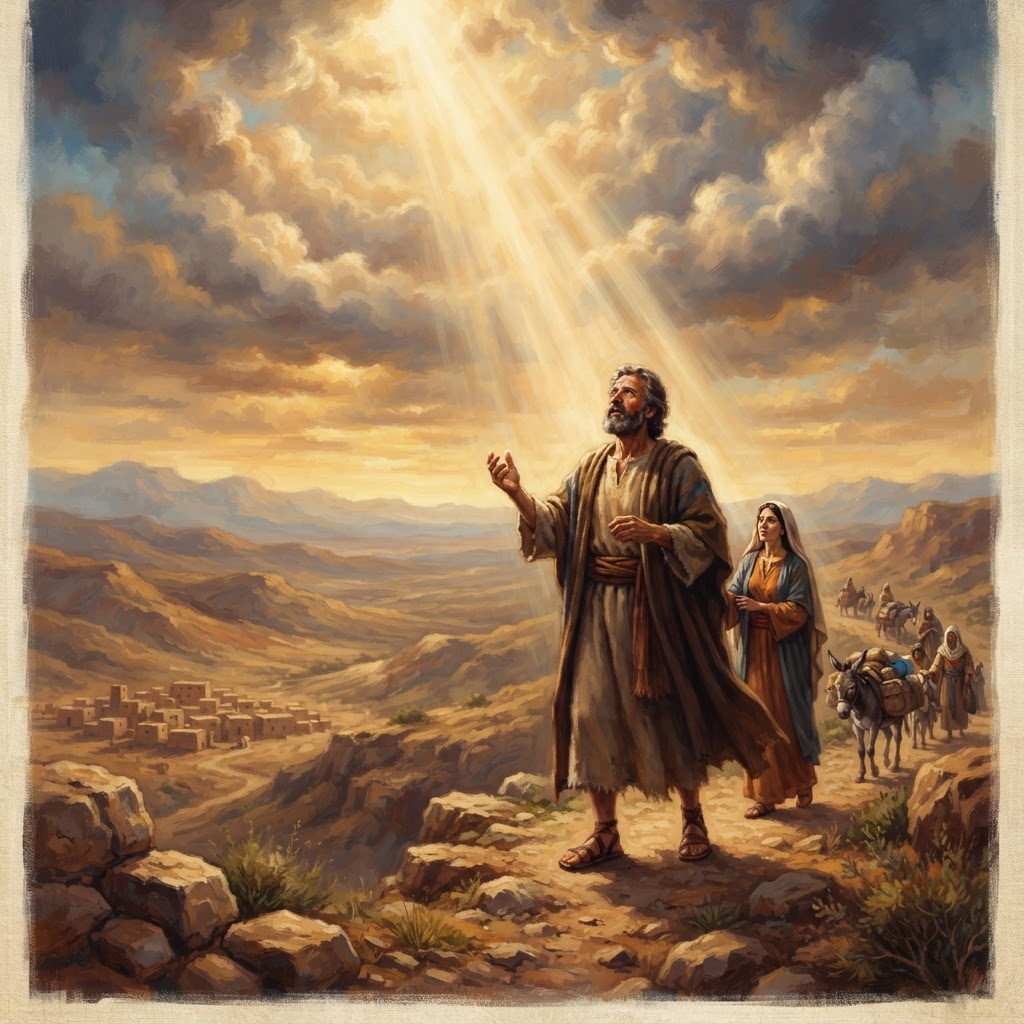
Day 6: The Call of Abram
God calls Abram to leave his home for a promised land, and he eventually rescues his nephew Lot from captivity.
Choose Your Experience
Introduction The transition from Genesis 11 to 12 marks the most significant pivot in the biblical narrative thus far. After the tragedy of the Fall in Eden, the corruption of the Flood, and the pride of Babel, humanity has effectively spiraled into global chaos. God’s redemptive solution is not a massive global rescue operation, but a quiet, intimate selection. He moves from the nations (plural) to one man (singular). We are moving from the primeval history (chapters 1-11) into the patriarchal history (chapters 12-50). The focus narrows to Abram, a man living in Ur of the Chaldeans, a center of paganism. God initiates a covenant that will eventually encompass all the families of the earth. ## Scripture in Focus In Genesis 12:1-3, God issues a radical command: 'Go from your country.' This was not merely a relocation; it was an act of severance from his ancestors, his land, and his security. God’s promise consists of land, offspring, and global blessing. Genesis 13 shows Abram’s character growth as he chooses peace over greed during his dispute with Lot. Genesis 14 introduces the first 'war' narrative, where Abram rescues Lot from a coalition of kings and encounters the mysterious Melchizedek. Melchizedek, the King of Salem, offers bread and wine and blesses Abram, representing an eternal priesthood that precedes the Levitical system and points directly to Christ. ## Key Themes 1. Covenantal Grace: God initiates the promise before Abram does anything to earn it. It is entirely a work of sovereign grace. 2. The Principle of Election: God selects one individual to be the conduit of salvation for the many. This is the structural blueprint for the ministry of Jesus Christ. 3. Faith as Obedience: Abram’s faith is not a sentiment; it is a 'going.' Hebrews 11 notes he went 'not knowing where he was going.' 4. The Blessing of the Nations: The ultimate goal of the Abrahamic Covenant is the universal reconciliation of humanity back to God. ## Going Deeper The Hebrew verb for 'go' in Genesis 12:1 is 'lek-leka,' which can be translated as 'go for your own good' or 'go for yourself.' It implies an intimate journey. The name 'Abram' means 'Exalted Father,' while 'Sarai' remains barren, highlighting the impossibility of the promise. In Genesis 14, the term 'El Elyon' (God Most High) is used. It is significant that a pagan king acknowledges the God of Abram. The encounter with Melchizedek is a profound typology; as David writes in Psalm 110, the Messiah is a priest forever in the order of Melchizedek, transcending earthly tribal genealogies. ## Application for Today How often do we let our fear of the unknown paralyze our obedience? Abram had to leave the familiar to find the promise. For us, 'leaving' might mean letting go of a sinful comfort, a prideful identity, or a reliance on human systems. We are called to live as pilgrims, 'strangers and exiles' on the earth, knowing that the city we seek is the one designed by God. Our lives are to be proof of the promise, pointing others toward the blessing of Christ. ## Reflection and Prayer Spend time reflecting on what God might be calling you to leave behind in order to fully embrace the future He has for you. Ask for the courage to walk by faith, not by sight. 'Lord, thank You for the beauty of Your plan. Even when I feel small or uncertain, remind me that You are the God of the covenant, the one who brings life out of barrenness and light out of darkness. Help me to trust You like Abram, to step forward in faith, and to be a blessing to those around me. In Jesus' name, Amen.'
Key Takeaway
The call of Abram shifts the biblical focus to a covenant of grace, establishing that God chooses the individual to be the vehicle of redemption for all nations through faith.
Family Discussion
1. In what ways does God’s call for Abram to leave his 'country, kindred, and father's house' challenge your current comfort and attachments?
2. How does the character of Melchizedek in Genesis 14 deepen our understanding of Christ as both King and Priest?
3. Why do you think the narrative emphasizes Abram's choice to be a peacemaker with Lot before God repeats the promise of the land?
4. How does the promise that 'all the families of the earth' will be blessed through Abram find its fulfillment in the New Testament?
Quick Quiz
Sign in to test your knowledge and track your progress.
Sign In to Take QuizMore from This Series

Bible in a Year
Day 1: The Beginning of Everything
18 min

Bible in a Year
Day 2: The Fall of Humanity
18 min
Bible in a Year
Day 3: The Generations Before Noah
18 min
Bible in a Year
Day 4: The Great Flood Begins
18 min
Bible in a Year
Day 5: Gods Promise After Flood
18 min
Bible in a Year
Day 7: Gods Covenant With Abram
18 min
Bible in a Year
Day 8: Judgment on Sodom
18 min
Bible in a Year
Day 9: The Birth of Isaac
18 min
Bible in a Year
Day 10: A Wife for Isaac
18 min
Bible in a Year
Day 11: The Life of Job
18 min
Bible in a Year
Day 12: Jobs Three Friends Speak
18 min
Bible in a Year
Day 13: Jobs Response to Friends
18 min
Bible in a Year
Day 14: Jobs Plea for Mediation
18 min
Bible in a Year
Day 15: Zophar Challenges Job
18 min
Bible in a Year
Day 16: Jobs Deepest Despair
18 min
Bible in a Year
Day 17: Accusations of Wickedness
18 min
Bible in a Year
Day 18: Jobs Search for Justice
18 min
Bible in a Year
Day 19: Gods Wisdom in Suffering
18 min
Bible in a Year
Day 20: The Complexity of Suffering
18 min